
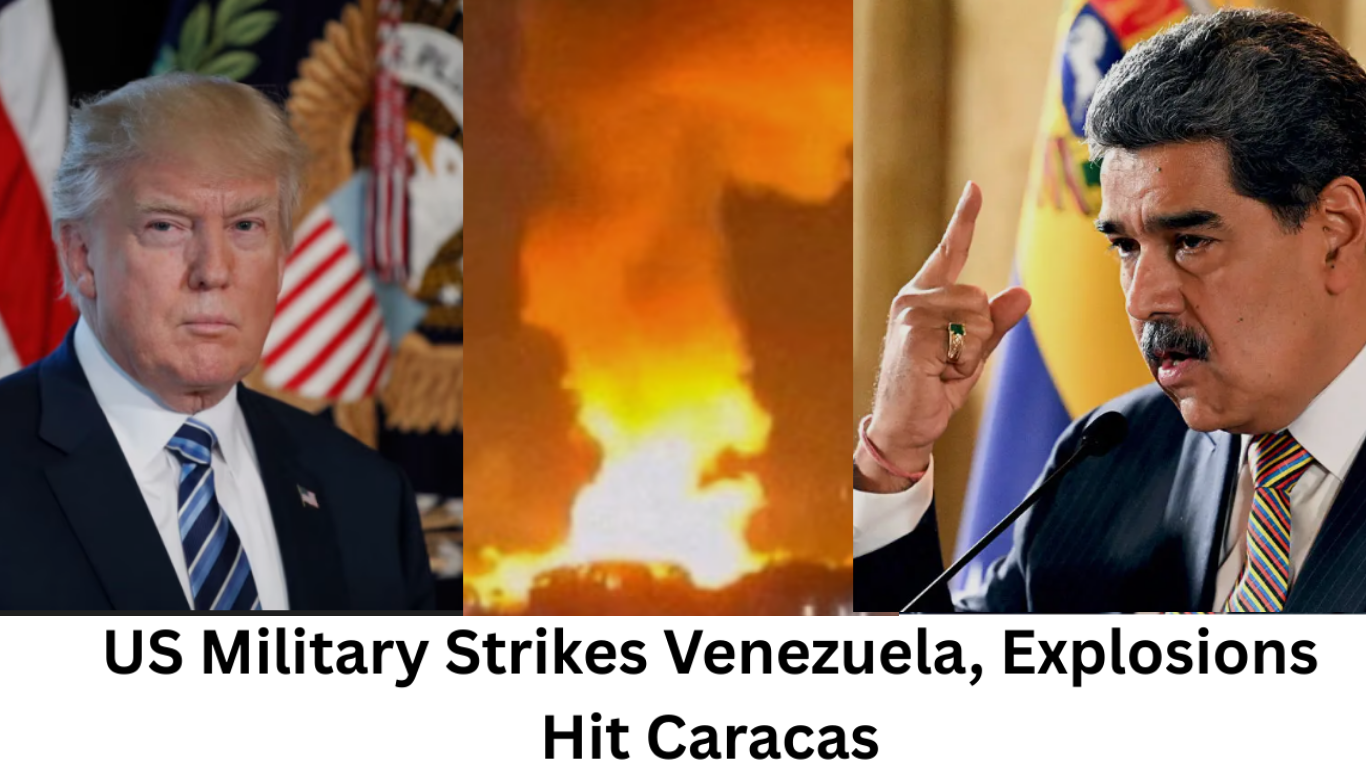
Caracas / Washington, January 4, 2026: Explosions tore through parts of Caracas, Venezuela, early Sunday following a series of US military strikes aimed at targets linked to the Nicolás Maduro government, drawing swift condemnation worldwide and heightening geopolitical tensions. Venezuelan authorities declared a national emergency and reported multiple blasts in residential and strategic areas of the capital, as residents took shelter amid chaotic scenes.
The strikes represent a significant escalation in US–Venezuela relations and have drawn criticism as a return to interventionist policy. The Venezuelan government denounced the action as unlawful “imperialism,” while the United States said it targeted alleged criminal and terrorist networks operating with government support.
Table of Contents
ToggleExplosions and Immediate Impact

Around dawn, residents in Caracas reported at least several loud explosions, accompanied by the sound of low-flying aircraft. Photographs distributed by international news outlets showed plumes of smoke rising above urban areas, damaged structures, and panicked civilians fleeing into the streets.
Video and photo coverage from wire services documented emergency responders, damaged facades, and significant power disruptions in parts of the city. There were reports of injuries, though independent casualty figures are not yet confirmed. Schools and businesses in affected districts were evacuated as authorities urged calm.
US Government’s Stated Justification
Officials in Washington said the operation was aimed at disrupting financial and operational networks tied to illegal narcotics trafficking and extremist groups allegedly protected by Venezuelan officials. A senior US official described the action as a legal response to threats emanating from within Venezuelan territory.
The US government framed the intervention as part of a broader strategy to curb regional security risks, though the move has reignited fierce domestic debate and international scrutiny over the legality and broader intent of the action.
Venezuela’s Response and Allegations of Imperialism
Venezuelan President Nicolás Maduro condemned the strike as an act of “naked imperialism,” accusing the United States of violating the nation’s sovereignty and attempting to force political change. Maduro ordered heightened defense readiness and called on citizens to prepare for further unrest, framing the response as patriotic resistance against aggression.
Government officials and state media called upon international organizations to intervene, asserting that the strikes constituted clear breaches of international law. Early statements suggested damage to both military facilities and nearby civilian structures.
Immediate Regional Reactions
The response from global actors was swift and sharply divergent:
China condemned the attacks as an infringement on sovereignty and said the action threatens regional peace and security.
Russia labeled the strikes “an unacceptable use of force” that undermines international norms.
Cuba and other Latin American governments denounced what they called external meddling in internal affairs.
European countries expressed concern regarding civilian safety and urged restraint and diplomatic channels.
In a notable development, North Korea responded by firing multiple ballistic missiles during the crisis, described by Pyongyang as a message against US military aggression in Venezuela. The missile firings were widely interpreted as symbolic support for nations opposed to US intervention.
International Legal and Diplomatic Debate
Legal scholars and experts in international relations weighed in, questioning the legality of unilateral military action on sovereign soil without clear United Nations Security Council authorization. Critics argue such actions undermine the framework of the UN Charter and established norms governing use of force.
US officials countered that the operation falls within the scope of self-defense and counter-terrorism measures, pointing to statutes and agreements they say permit action against entities linked to criminal networks. The debate over the legal grounding and long-term implications continues among international institutions and academic circles.
Broader Global Implications
Analysts say the strikes could destabilize an already fragile region, potentially fueling migration flows, economic disruption, and political polarization across Latin America and beyond. Venezuelan oil exports, already constrained by internal policy and sanctions, face further uncertainty as foreign companies and investors reassess risk.
The unfolding situation has triggered emergency meetings of regional coalitions and calls for diplomatic engagement to prevent further military escalation.
Outlook and Next Steps
As night fell in Caracas, the situation remained tense. International mediators and foreign ministers from multiple countries signaled openness to negotiations, but clear pathways to de-escalation were not immediately evident. The United Nations is expected to convene discussions focused on humanitarian needs, legal accountability, and mechanisms for preventing further conflict.
The coming days and weeks will be critical in determining whether the Venezuela strikes lead to wider confrontation or prompt renewed global efforts toward negotiation and stability.
Key Facts at a Glance
US military strikes hit targets in Venezuela early January 2026
Explosions reported in Caracas; emergency declared
Venezuelan government calls it violation of sovereignty
China, Russia, Cuba condemn the action
North Korea conducts missile tests in apparent political message
Questions raised internationally about legality and precedent
Visit GPS NEWS HUB