
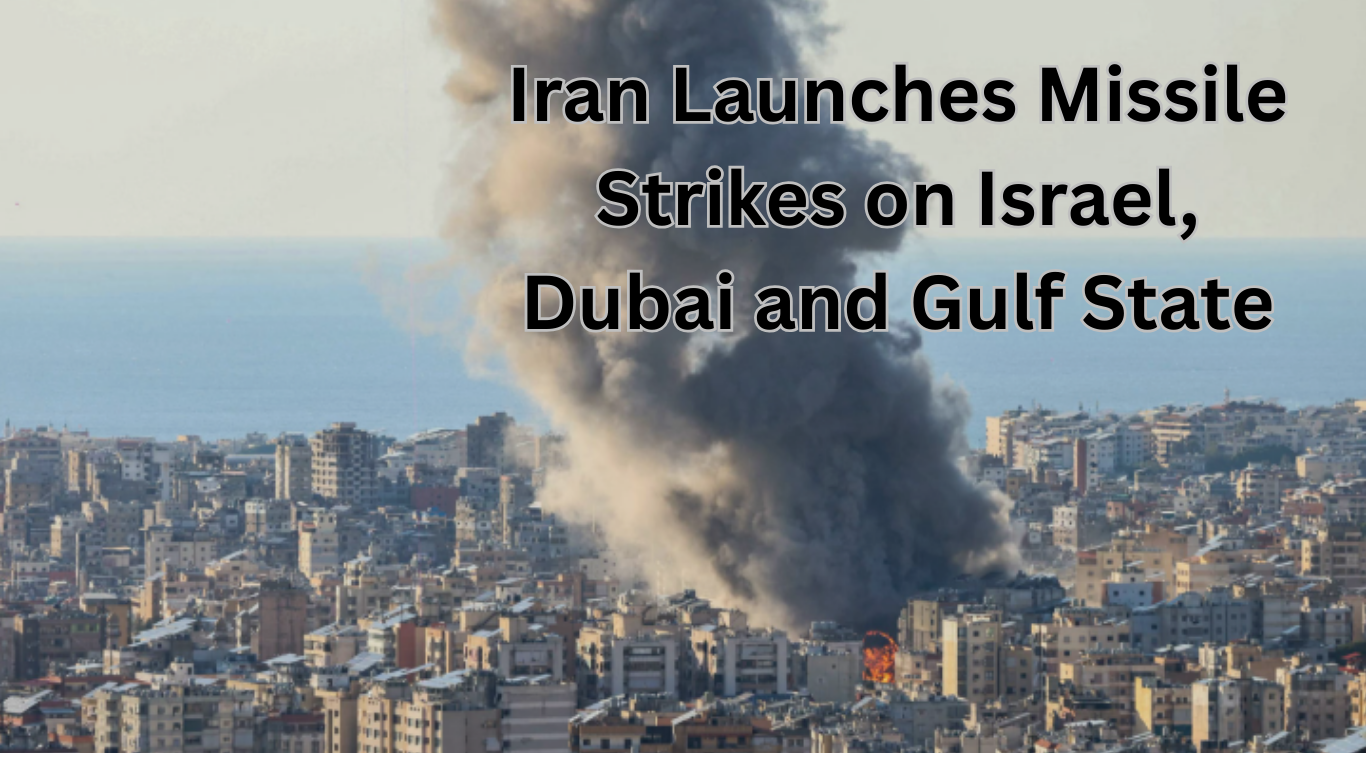
The Middle East has plunged into one of its most volatile military confrontations in years after Iran launched coordinated missile and drone strikes on Israel, the United Arab Emirates, Qatar, Saudi Arabia, and Kuwait in retaliation for an earlier US-Israeli airstrike that killed Iran’s Supreme Leader Ayatollah Ali Khamenei.
The exchange marks a significant escalation in hostilities, involving direct strikes on multiple countries across the region and prompting emergency responses, evacuations, and air defence activations. Civilians and infrastructure — including Dubai International Airport — have been impacted as leaders in the United States, Europe, and Arab states call urgently for de-escalation.
Table of Contents
ToggleIran’s Waves of Missile and Drone Strikes
According to official statements and live updates from regional news agencies, Iran launched a combination of ballistic missiles and unmanned aerial vehicles (UAVs) targeting military and strategic installations across several Gulf states. Explosions were reported near air bases, defence sites, and energy infrastructure.
In Israel, air-raid sirens blared across major cities as defence systems, including the Iron Dome, intercepted incoming projectiles. Authorities reported minimal casualties after successful interceptions, but infrastructure damage and wide-scale disruptions were reported.
In Dubai, blasts near Dubai International Airport caused damage to the perimeter and temporarily halted flight operations, injuring several civilians. Airports in Doha and other Gulf capitals activated emergency protocols as a precautionary measure, with flights diverted or delayed.

US and Israeli Military Response
The United States, a staunch ally of Israel and key security partner for Gulf states, has responded with additional air and naval deployments in the region, reaffirming its commitment to defending partner nations. There have been reports of targeted US strikes against Iranian command and control facilities, although officials have not confirmed details of specific operations.
Israeli forces also conducted retaliatory strikes targeting Iranian assets in Syria and Iraq. Israeli Prime Minister Netanyahu warned that attacks on Israel would be met with resolute and persistent force.
Regional Governments Sound Alerts
Across the Gulf Cooperation Council (GCC) states, governments issued emergency alerts to residents, urging caution and warning of potential further strikes. Qatar’s civil defence forces activated sirens in Doha, while Saudi Arabia and Kuwait reported enhanced air defence readiness.
Authorities in each country stressed that they were acting to protect civilian populations and critical infrastructure, but acknowledged uncertainty about the duration of the conflict.
Global Diplomatic Reaction
World leaders have expressed deep concern over the escalation. The United Nations Security Council held an emergency session, with several members calling for immediate de-escalation and restraint. European Union officials urged dialogue and peace initiatives, warning that the conflict could destabilise global security and energy markets.
Indian and other governments also echoed the call for calm, with foreign ministries urging their citizens in the region to stay indoors and follow safety instructions from local authorities.
Human and Economic Impact
While confirmed casualty figures remain limited as of reporting, the economic repercussions are significant. Flight cancellations and diversions out of Dubai and other Gulf hubs are expected to disrupt global travel and commerce. Oil prices have jumped sharply on fears of supply chain disruptions, as the Gulf region remains critical to global energy flows.
Residents reported hearing repeated explosions overnight and described scenes of confusion at airports and city streets. Hospitals in border regions and major cities remain on high alert for potential mass casualty situations.
Historical Context and Escalation Risks
Analysts note that this escalation stems from one of the most consequential events in recent Middle East geopolitics: the killing of Ayatollah Khamenei, a deeply influential figure in Iranian politics and regional strategy. Iran’s response, involving multiple nation-state targets, reflects both a show of capability and willingness to engage in broad retaliation.
Security experts caution that the conflict could widen if other regional actors, including Hezbollah in Lebanon, join hostilities, or if proxy militias aligned with Iran respond in Iraq, Syria, or Yemen.
What Happens Next
With both sides entrenched, diplomatic avenues remain uncertain. Washington has reportedly engaged back-channel talks with regional partners to prevent further escalation, but military readiness across the region remains elevated.
For now, citizens across the Middle East are bracing for further blows and uncertainty. The security situation continues to evolve rapidly, with global markets, migrants, and international relations increasingly affected as the world watches whether diplomatic efforts can avert broader war.
Visit GPS NEWS HUB