
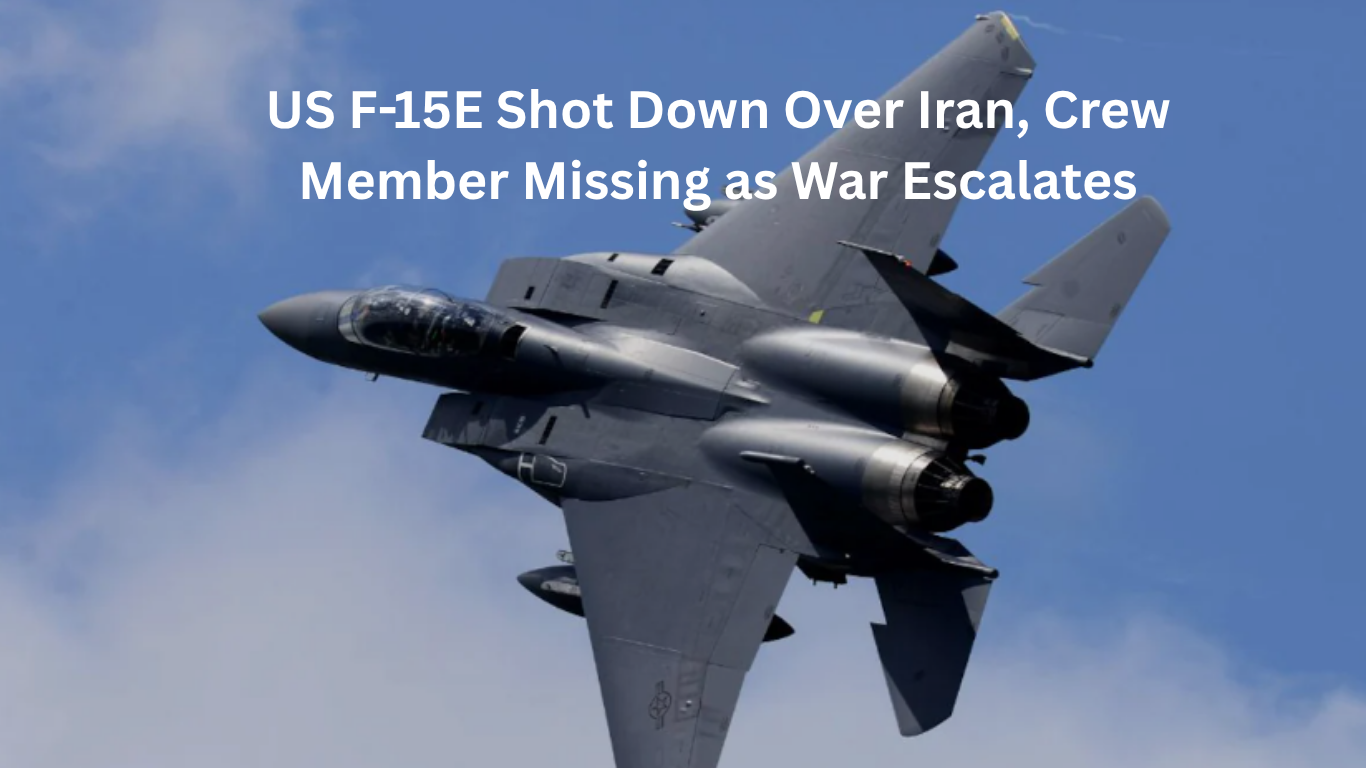
A United States Air Force F-15E Strike Eagle fighter jet was shot down over Iran on Friday, with one crew member rescued and the fate of a second still unknown, as the 35-day-old conflict between the U.S., Israel, and Iran entered a dangerous new phase. A second American combat aircraft was struck the same day, forcing its pilot to eject before escaping Iranian airspace.
The incidents mark the most serious single-day loss of U.S. military aircraft since the campaign began, raising alarm in Washington and drawing sharp criticism from lawmakers on both sides of the political aisle.
Table of Contents
ToggleTwo Aircraft Hit in Single Day
One crew member from the downed F-15E was rescued and is alive and receiving medical treatment. The status of the second crew member remains unclear.
A second U.S. military plane — an A-10 Thunderbolt II — was also struck by Iran on the same day, forcing the pilot to eject. The pilot was able to navigate the aircraft out of Iranian territory before ejecting and was subsequently rescued.
Iran’s military claimed responsibility for both incidents. However, discrepancies in Tehran’s account raised questions about its reliability. An Iranian spokesperson claimed an F-35 was brought down over central Iran by a new type of air defense system operated by the Islamic Revolutionary Guard Corps (IRGC). However, photos of wreckage published by Iranian state media clearly showed parts consistent with an F-15E Strike Eagle, not an F-35.
Specifically, the tail fin visible in the photos indicated an aircraft assigned to the 494th Fighter Squadron at RAF Lakenheath in England — one of the units deployed to the U.S. Central Command area of operations for Operation Epic Fury.

Iran Offers Reward, Mocks U.S. Search Effort
Tehran moved quickly to exploit the crisis. Iran claimed responsibility for shooting down the F-15 and announced a reward for Iranians who find and hand over an American service member.
Iran’s parliament speaker Mohammad Bagher Ghalibaf publicly mocked Washington’s search efforts on social media, dismissing the U.S. military campaign in pointed terms. He also issued a veiled threat against the Bab el-Mandeb Strait — a key Red Sea shipping chokepoint — in posts that referenced the volume of global oil and grain trade passing through the waterway, widely interpreted as a signal that Iran could seek to disrupt a second critical shipping lane beyond the Strait of Hormuz.
Trump: Jet's Downing Will Not Affect Negotiations
President Donald Trump told NBC News on Friday that the downing of the fighter jet would not affect any negotiations with Iran. “No, not at all. No, it’s war. We’re in war,” he said in a brief phone interview.
Trump did not publicly comment on the search and rescue mission. He separately posted on Truth Social that the U.S. could “easily” reopen the Strait of Hormuz — a shift from his earlier position that other nations bore responsibility for clearing the waterway.
Political Pressure Grows in Washington
The losses intensified pressure on the administration from within its own party. Republican Senator John Curtis of Utah said he “cannot support funding for further military operations” without a formal declaration of war from Congress, citing both the Constitution and concerns about historical precedent.
Democratic Representative Seth Moulton, a member of the House Armed Services Committee, questioned the administration’s strategy directly, saying the Trump team does not “know how to get out of this mess” and does not “know how to end this war.”
Search and Rescue Continues
Israel postponed some of its planned strikes in Iran on Friday to avoid interfering with the U.S. search and rescue operation and offered intelligence support, according to two Israeli sources.
As of Saturday morning, the search for the second F-15E crew member was continuing, with U.S. forces operating deep inside Iranian airspace. The Pentagon has not confirmed the service member’s identity or current status.
Sources: CNN, The War Zone, U.S. Central Command, NBC News
Visit GPS NEWS HUB