
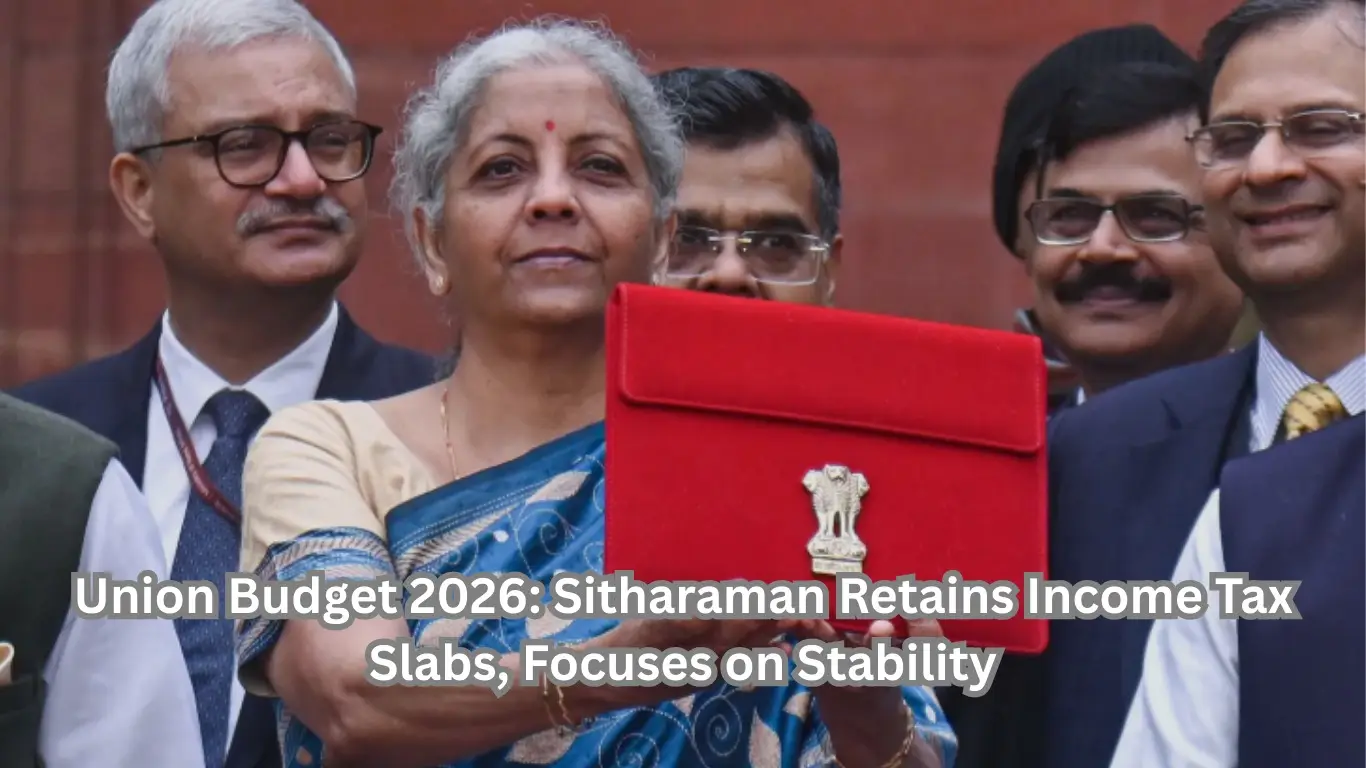
Finance Minister Nirmala Sitharaman presented the Union Budget 2026 in Parliament on Thursday, maintaining continuity in personal income tax slabs under the new tax regime while avoiding any increase in rates. The budget, which outlines the government’s fiscal priorities for the year ahead, struck a balance between sustaining economic momentum and managing fiscal prudence, drawing attention from markets, businesses, and taxpayers alike.
The new tax regime — introduced several years ago with lower slab rates and simplified structure but fewer exemptions — remains the central framework for personal taxation. Significantly, Sitharaman chose not to announce any immediate plans to phase out the old tax regime, which continues to be available to taxpayers who prefer deductions and exemptions under the traditional system. This decision provides stability and predictability to millions of taxpayers as they plan their finances for the coming year.
Table of Contents
ToggleTax Regime Continuity and Policy Direction
In her budget speech, Sitharaman underscored the government’s priority of steady economic growth, job creation, infrastructure investment, and fiscal consolidation. In the context of personal taxation, she reiterated that the new tax regime with its lower slab rates would continue to be the recommended path for most taxpayers, given its simplicity and reduced compliance burden.
However, she also clarified that the government had no immediate plan to phase out the old tax regime entirely, responding to concerns raised by taxpayers and industry bodies. “Both regimes will co-exist, and individuals may choose the option that best suits their financial planning requirements,” Sitharaman said, placing emphasis on taxpayer choice and flexibility.
Tax experts welcomed the announcement, noting that no major changes to tax slabs or rates will help individuals and businesses forecast liabilities with greater certainty. They also pointed out that while exemptions remain available under the old regime, the simplicity of the new regime has attracted a growing number of taxpayers over recent years.

Fiscal Priorities and Allocations
Beyond tax policy, the Budget 2026 set out a broad range of fiscal priorities. Sitharaman emphasized increased capital spending on infrastructure, healthcare, and education, with a focus on accelerating economic growth in both urban and rural areas. Allocation toward digital infrastructure, energy transition, and MSME support also featured prominently.
Among infrastructure plans, emphasis was placed on road and rail networks, urban transit systems, and regional connectivity. Sitharaman reaffirmed the government’s pledge to enhance India’s logistics competitiveness by reducing bottlenecks and improving ease of doing business.
In the social sector, the budget proposed enhanced outlays for public health initiatives — including preventive care — and educational reforms aimed at skill development and employability. Rural development schemes retained their importance, with stress on agricultural value chains and credit support for small producers.
Budget Rituals and Culture
In a moment that attracted media attention ahead of the budget presentation, President Droupadi Murmu offered a traditional “dahi-cheeni” (curd and sugar) to the Finance Minister on the morning of the budget. This cultural gesture is rooted in Indian tradition, symbolizing goodwill, sweetness, and auspicious beginnings. The gesture set a positive tone before Sitharaman’s formal walk into Parliament to deliver the budget speech.
Market and Public Response
Initial reactions from markets were positive, with the benchmark indices showing modest gains as investors welcomed the continuity in tax policy and clarity on fiscal priorities. Analysts said the absence of major tax changes eased uncertainty, allowing businesses and households to plan with confidence.
Public response appeared mixed; while many welcomed the stability in tax slabs, some commentators expressed disappointment that the old system was not streamlined further or phased out more decisively. Tax policy commentators noted that retaining dual regimes reflects the government’s cautious approach to reform, seeking to balance simplicity with taxpayers’ varied needs.
As the fiscal year unfolds, implementation of the budgetary allocations and reform measures will be watched closely by economists, businesses, and citizens alike. With elections on the horizon, the government’s ability to deliver growth while maintaining fiscal discipline will continue to shape policy debate in India.
Visit GPS NEWS HUB