
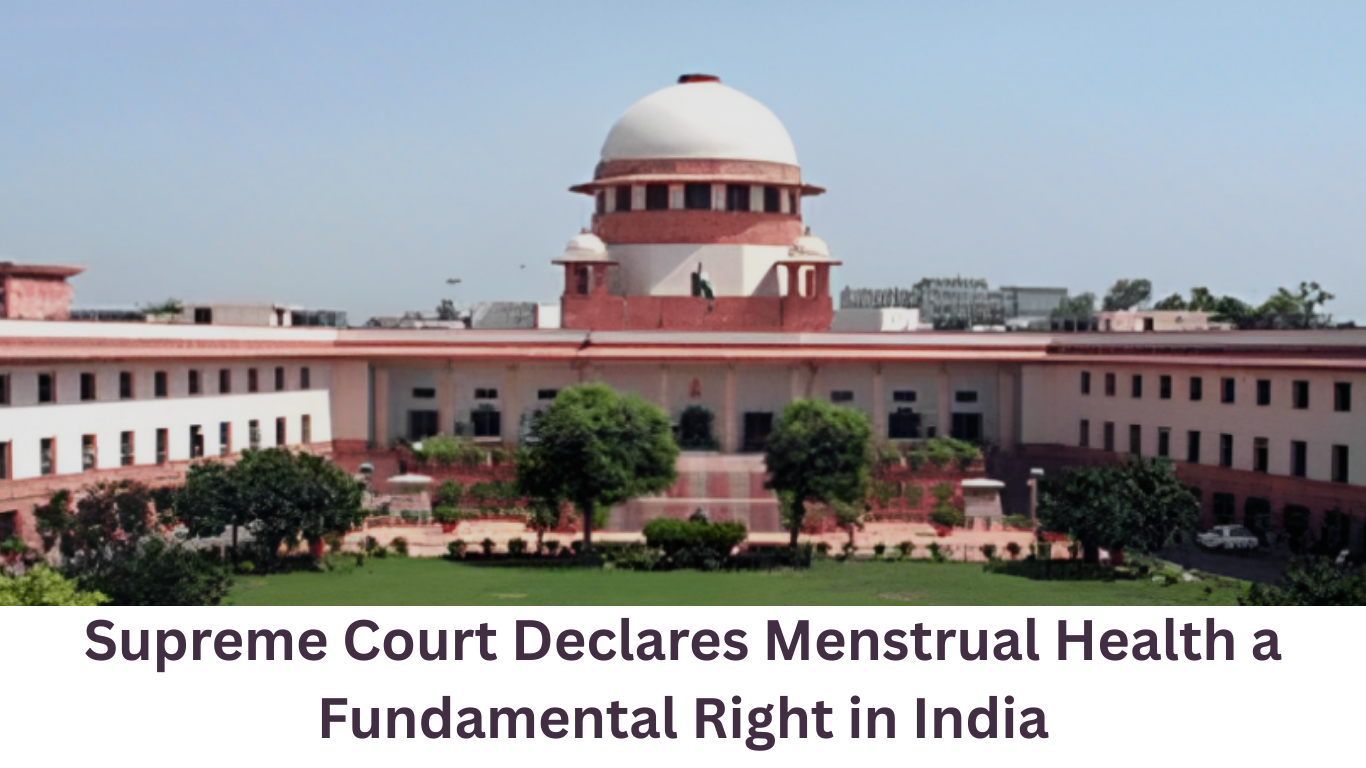
In a landmark decision, the Supreme Court of India on Thursday ruled that menstrual health is a fundamental right under Article 21 of the Constitution, which guarantees the right to life and personal dignity. The judgment also directs all schools to ensure access to free sanitary pads for girls and mandates the provision of separate, menstrual-friendly toilets, reinforcing the government’s responsibility to uphold menstrual hygiene as a basic public health issue.
The order came in response to petitions challenging the pervasive lack of menstrual hygiene infrastructure and products in many educational institutions across the country. In its judgment, a Constitution Bench of the Supreme Court underscored that menstrual health “lies at the very heart of human dignity, self-respect and bodily autonomy,” and that denial of access to sanitary products and facilities infringes on the fundamental right to life.
Table of Contents
ToggleLandmark Constitutional Recognition
By declaring menstrual health a fundamental right under Article 21, the Supreme Court broke new ground in how reproductive and public health issues are understood under Indian constitutional law. The bench observed that menstruation, a biological reality for half the population, must not be shrouded in stigma, and that the state has a direct responsibility to ensure equitable access to health services and infrastructure that support menstrual hygiene.
Article 21 has historically been interpreted expansively to safeguard personal liberty, dignity, and bodily rights. The latest ruling aligns menstrual health with these principles, placing it on par with other essential health rights recognized by the judiciary in previous decisions, such as the right to privacy and the right to healthcare.
Directives to Schools and Authorities
The Supreme Court issued specific directions aimed at improving menstrual hygiene access in educational settings, particularly in rural and semi-urban areas. Key mandates include:
Provision of free sanitary pads in all government and government-aided schools for girl students.
Installation of separate, well-maintained toilets for girls with facilities for safe disposal of sanitary waste.
Awareness and education programmes on menstrual health and hygiene for students and teachers.
The court also directed the central and state governments to implement these measures within a specified timeframe and to regularly report progress to ensure accountability and compliance.

Public Reaction and Civil Society Response
The judgment drew widespread praise from women’s rights activists, public health experts, and civil society organisations who have long campaigned for menstrual equity. Many welcomed the constitutional recognition of menstrual health as a fundamental right, calling it a “transformative step” that could reshape public discourse and policy.
“This ruling acknowledges the lived realities of millions of menstruators across India,” said a representative of a national women’s health coalition. “By affirming menstrual health as part of the right to life, the Supreme Court has set a precedent that will have far-reaching impacts on gender equity and health justice.”
Policy and Implementation Challenges Ahead
While the ruling marks a major legal and symbolic victory, experts caution that the real test lies in effective implementation. India has a population of over 120 million menstruating adolescents and women of school age, many of whom still lack access to affordable sanitary products and basic sanitation infrastructure. Poor menstrual hygiene has been linked to increased absenteeism among schoolgirls and various health risks, including reproductive tract infections.
To meet the court’s directives, governments at the central and state levels will need to allocate resources, strengthen supply chains for sanitary products, and integrate menstrual health education into school curricula. Ensuring culturally sensitive awareness campaigns and training for teachers and health workers will be critical to destigmatizing menstruation in communities where silence and discrimination remain entrenched.
Looking Forward
As India moves to implement the Supreme Court’s decision, the ruling is likely to influence broader public health policy and legislative reforms. Advocates hope that the recognition of menstrual health as a fundamental right will serve as a catalyst for sustained action, bridging gaps in access, dignity, and gender justice across the country.
Visit GPS NEWS HUB