
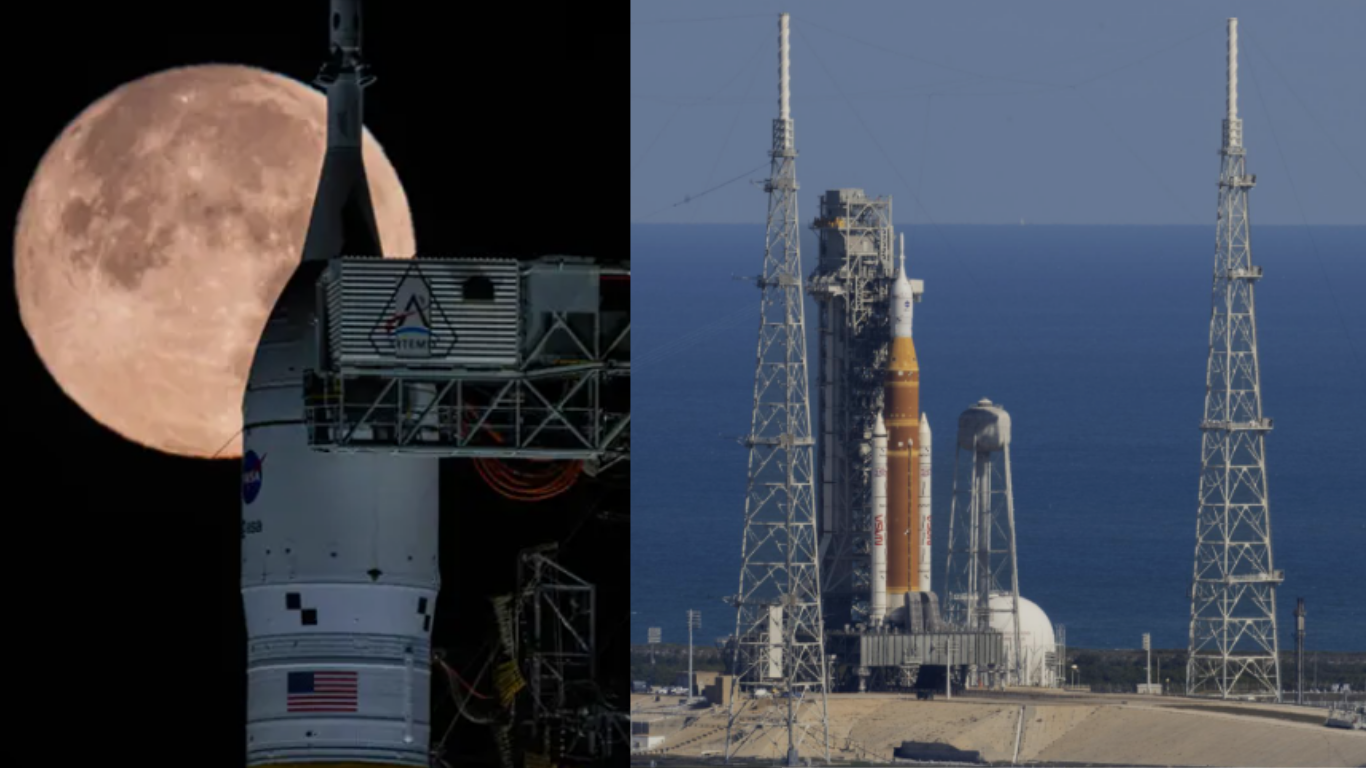
NASA’s Artemis II mission — the first crewed flight in the agency’s return to lunar space — encountered a setback during a critical wet dress rehearsal conducted at NASA’s Kennedy Space Center in Florida earlier this week. The test, which took place on February 3, 2026, was halted prematurely after launch controllers detected a technical issue during countdown operations.
The rehearsal, designed to simulate launch-day procedures including fueling the Space Launch System (SLS) rocket and conducting system checkouts of the Orion spacecraft, was stopped approximately five minutes and 15 seconds before the planned engine ignition. NASA said the decision was taken as a precaution to allow engineers to review the anomaly and prevent potential risks ahead of the mission’s crewed launch.
The agency has begun a detailed analysis of test data to identify the cause of the issue, noting that wet dress rehearsals are specifically intended to uncover problems well before a launch attempt. Artemis II remains a landmark mission, expected to send a crew of astronauts on a lunar flyby using the same hardware that will support future Moon landings under NASA’s Artemis program.
Table of Contents
ToggleWhat is a Wet Dress Rehearsal?
A wet dress rehearsal is a comprehensive pre-launch test that replicates nearly every aspect of the launch countdown — short of actually firing the rocket’s engines. It includes:
Loading liquid oxygen and liquid hydrogen propellants into the SLS core stage and upper stage
Testing the ground support systems
Checking connections between the rocket and Orion
Running through procedural steps the launch team would follow on launch day
Sometimes referred to as a “countdown dress rehearsal,” this exercise is essential for identifying procedural, hardware, or communication issues that could jeopardise crew safety on launch day. The termination of the Artemis II test at T-515 — still more than four hours before the official planned ignition — was precisely why this kind of test exists: to catch problems early and allow time to fix them.
What Happened During the Test?
Preliminary information from NASA indicates that teams detected an unspecified anomaly during the pressurisation phase of propellant loading, prompting a controlled shutdown of operations as a safety precaution. NASA did not identify the specific hardware or subsystem involved, but engineers will now pore through telemetry data and system logs to isolate the root cause.
No personnel were ever at risk; no hazardous conditions were present, and the launch team has long trained to respond to just these kinds of contingencies. A NASA spokesperson emphasised the conservative approach and emphasised that no injuries or damage occurred.

Significance of Artemis II
Artemis II is currently scheduled to launch later in 2026 from Launch Complex 39B at NASA’s Kennedy Space Center in Florida. It will carry four astronauts — including those selected for the first crewed Artemis mission — on a mission that will take them around the Moon and back to Earth. The flight is an important step toward NASA’s long-term goal of establishing a sustained human presence on and around the Moon.
In addition to demonstrating Orion and SLS capabilities with crew onboard, Artemis II will validate life support, navigation, and deep space communication systems that will be critical for Artemis III, the mission that aims to land the next humans — including the first woman and first person of color — on the lunar surface.
Reactions from NASA and Space Community
NASA leadership characterised the wet dress rehearsal stop as routine in complex spaceflight testing. “These tests are designed to uncover issues so we can fix them before we get to crewed operations,” a NASA official said.
Spaceflight analysts and engineers also noted that problems during fueling rehearsals are not uncommon for heavy launch vehicles with cryogenic propellants. The key takeaway for them — and for the agency — is that NASA responded quickly and safely, maintaining control of the rocket and support systems.
Observers continue to see the Artemis program as one of the most ambitious in civilian space exploration history, spanning years of research and development. The wet dress rehearsal will be rescheduled after a full review of the test data and subsequent corrective actions.
Next Steps for Artemis II
NASA has not yet announced a revised timeline for another wet dress rehearsal or for the Artemis II launch itself. Before the final rehearsal can be attempted, engineers will need to confirm:
Identification and resolution of the issue
Re-verification of all launch systems
Updated safety checks
NASA has signaled that it will share more details as the investigation progresses and will aim to keep timelines on track without compromising crew safety or mission success.
Visit GPS NEWS HUB