
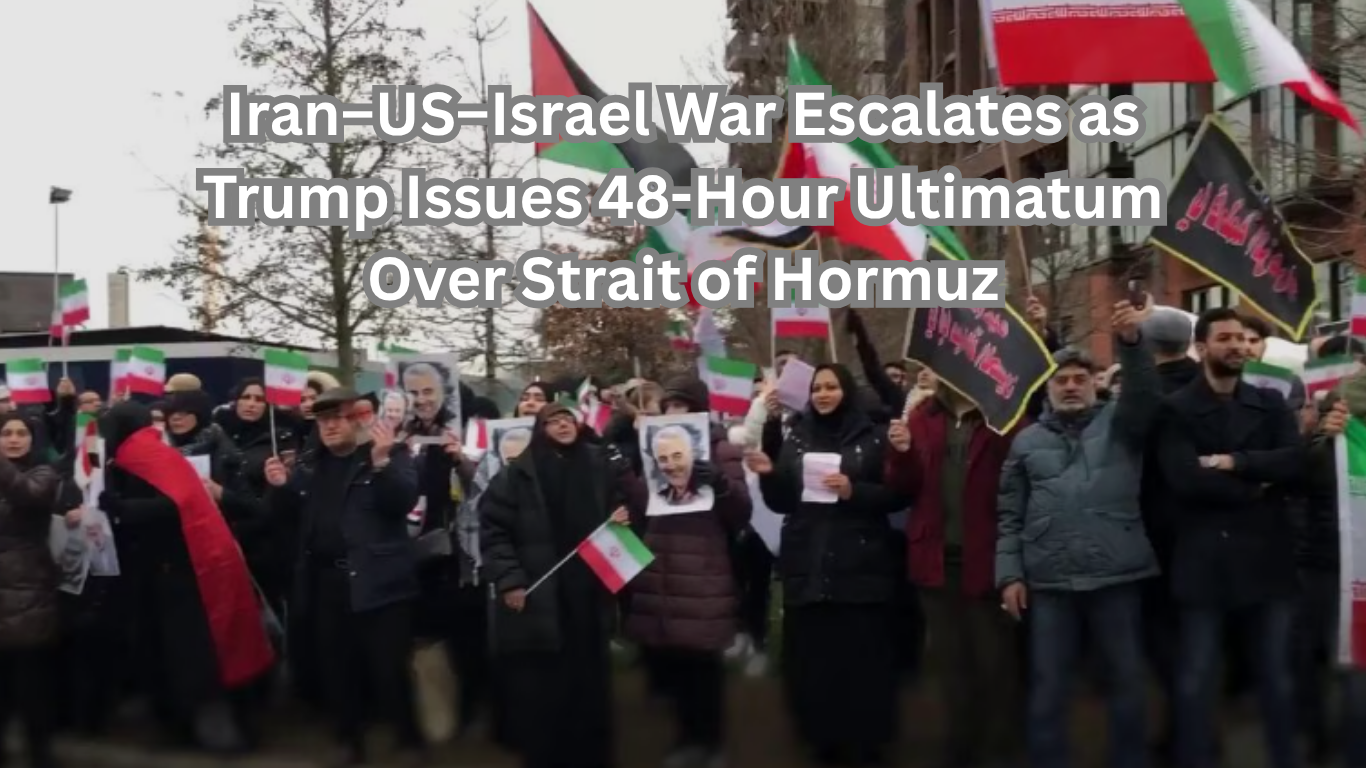
The ongoing Iran–US–Israel conflict entered a dangerous new phase on March 22, as military strikes intensified across the Middle East and diplomatic tensions sharply escalated. The crisis has been further aggravated by a strong ultimatum from US President Donald Trump, raising fears of a wider regional war and deepening global economic uncertainty.
Table of Contents
ToggleTrump Issues 48-Hour Ultimatum
In a dramatic escalation, President Trump warned Iran to fully reopen the Strait of Hormuz within 48 hours or face severe military consequences. He threatened that the United States would “obliterate” Iran’s power plants and critical energy infrastructure if the key shipping route remains restricted.
The Strait of Hormuz is one of the world’s most crucial oil transit chokepoints, carrying nearly 20% of global oil supply. Its disruption has already pushed crude oil prices above $100 per barrel and triggered global concerns over energy security.

Iran Responds With Conditional Access
Iran responded by stating that the strait remains open—but only to vessels not linked to countries it considers hostile. Tehran has effectively restricted access to ships associated with the United States, Israel, and their allies, escalating tensions over maritime security.
Iranian officials also warned that any attack on their energy infrastructure would be met with retaliation targeting US and allied assets across the region, including energy and technological facilities.
Intensifying Military Strikes
Heavy fighting continues across multiple fronts. Iranian missile attacks have struck Israeli territory, including areas near sensitive nuclear-related sites, injuring dozens. In response, Israel has carried out fresh airstrikes targeting locations in Tehran and other strategic areas.
The conflict has also expanded geographically, with attacks reported near US-linked bases and maritime zones. Missile and drone strikes have been recorded across the Gulf, while explosions near shipping routes have heightened fears for international trade and energy transport.
Global Energy and Economic Impact
The escalating crisis has severely disrupted global energy markets. With shipping through the Strait of Hormuz under threat, oil supplies have tightened, leading to rising fuel prices and inflation concerns worldwide.
Several countries have begun exploring military measures to secure shipping lanes, while others are urging restraint to avoid further escalation. Analysts warn that prolonged disruption could trigger a full-scale energy crisis affecting both developed and emerging economies.
Rising Humanitarian Concerns
The conflict has already resulted in significant casualties and displacement across multiple countries in the region. Reports suggest thousands have been killed or injured since the war began, with infrastructure damage affecting hospitals, energy facilities, and residential areas.
The growing humanitarian crisis has prompted calls from international organisations and global leaders for an immediate ceasefire, though diplomatic efforts have so far failed to produce concrete results.
Outlook for the Conflict
Despite rising global pressure, both sides continue to adopt aggressive positions. The US has signalled readiness for further military action, while Iran has vowed continued resistance and retaliation.
With tensions centered around the Strait of Hormuz—a vital artery for global energy—the risk of escalation remains extremely high. Analysts warn that any direct strike on energy infrastructure could trigger a broader regional war with far-reaching geopolitical and economic consequences.
As the situation unfolds, the Iran–US–Israel conflict is rapidly emerging as one of the most critical global crises in recent years, with implications that extend far beyond the Middle East.
Visit GPS NEWS HUB