
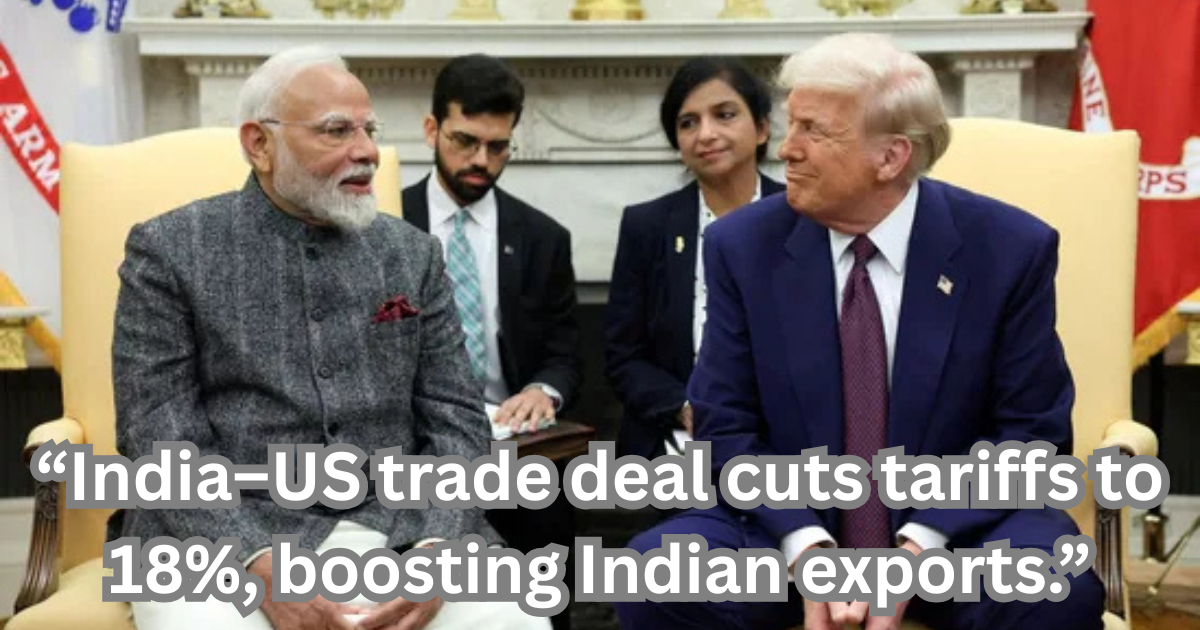
New Delhi / Washington, February 3, 2026( India-US Trade deal) — India and the United States have sealed a significant trade agreement that lowers reciprocal tariffs on Indian goods from 25 % to 18 %, in a development expected to strengthen bilateral economic ties and give Indian exporters a competitive edge in global markets. The announcement, confirmed by both capitals on Monday, marks a notable shift in trade policy after months of negotiations and recent tariff tensions between the two nations.
Table of Contents
ToggleTariff Cut to 18 % — What It Means for Indian Exports
Under the new agreement, the United States will charge an 18 % tariff on Indian imports, a marked reduction from earlier, higher rates. This move places India at a comparative advantage against many regional exporters, whose tariff rates in the U.S. market remain higher. India’s tariff rate is now lower than those applied to several key competitors, including Bangladesh, Vietnam, Indonesia and China.
Indian industry observers anticipate that textiles, garments, leather goods, seafood and other labour-intensive sectors stand to benefit the most from the improved market access. Lower tariffs make Indian products more price-competitive in the U.S. market, potentially stimulating demand and export growth.

Political Leaders Welcome the Deal
U.S. President Donald Trump announced the agreement shortly after a phone call with Indian Prime Minister Narendra Modi, describing it as a “mutually beneficial trade deal” and framed by close cooperation between the two leaders. Modi welcomed the tariff reduction as a boost for Indian business and a sign of deepening strategic ties. According to official statements, the agreement was reached “effective immediately,” and both sides emphasized the importance of bilateral cooperation.
In their public remarks, leaders also highlighted plans for expanded purchases of U.S. goods — including energy, technology and agricultural products — as part of efforts to enhance economic engagement.
Context: From Tensions to Trade Accord
The tariff cut comes after a period of elevated trade tensions between India and the United States, during which U.S. tariffs on Indian goods had been increased in stages. Earlier levies had reached punitive levels tied to India’s trade policies and energy imports, contributing to friction between the two major democracies.
The new deal not only eases tariff burdens for Indian exporters but also reflects broader diplomatic engagement to stabilize economic ties. Analysts note that the agreement complements other trade arrangements India has pursued with global partners, including recent pacts with the European Union and other regions that aim to diversify export routes and strengthen market access.

Business and Market Implications
The tariff reduction is expected to have positive ripple effects across India’s export-oriented sectors. Reduced duties can increase demand for Indian goods in the United States, potentially boosting shipments and supporting job creation in manufacturing and related industries. As Indian products face an 18 % tariff versus higher duties faced by some competitors, exporters may find new opportunities to scale their businesses in North American markets.
However, some industry experts caution that detailed implementation timelines and product-specific tariff structures are still unfolding, and the full impact will become clearer once regulatory procedures are finalized by both governments.
Looking Ahead
With the tariff cut now in place, both New Delhi and Washington have signalled a willingness to expand economic cooperation beyond tariffs, including discussions on investment, energy trade and technology partnerships. Business groups in both countries have welcomed the agreement, viewing it as a platform for sustained engagement.
For India, the trade deal reinforces a broader strategy to cement its role in global supply chains and enhance competitiveness while balancing diplomatic priorities on energy and security.