
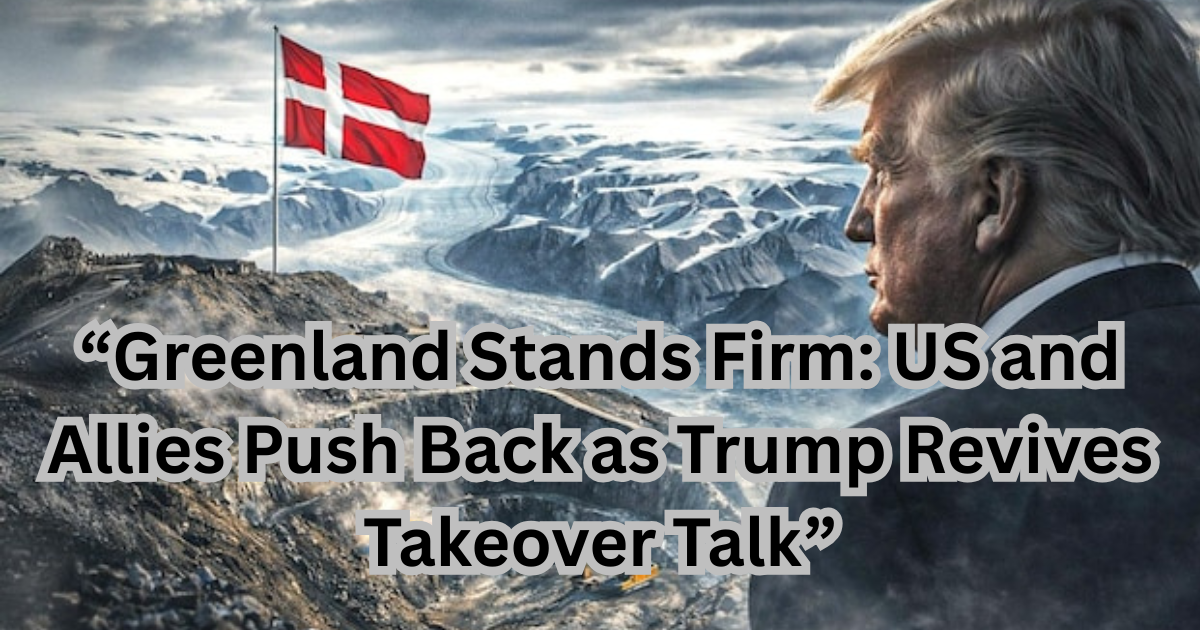
US President Donald Trump has reignited controversy by again asserting that the United States should acquire Greenland — a vast Arctic territory that is semiautonomous but constitutionally part of the Kingdom of Denmark — citing strategic national-security concerns amid broader geopolitical competition with Russia and China. The renewed focus has triggered strong diplomatic pushback from Greenlandic leaders, Denmark and European allies, and raised fresh questions about NATO unity and Arctic security cooperation.
Speaking at the White House, Trump said the United States needed to ensure that neither Russia nor China gained significant influence over Greenland’s strategic position in the Arctic. “We are going to do something on Green land whether they like it or not,” the president told reporters, reiterating that Washington’s actions might be necessary and could range from diplomatic negotiation to more forceful measures if required to secure the island.
Trump emphasized his view that acquiring control of Greenland would counter perceived threats from rival powers and bolster US defense in the High North. His comments echo earlier remarks that the island has significant strategic value due to its geographic location and the presence of military infrastructure relevant to early-warning systems and Arctic operational reach.
Table of Contents
ToggleGreenland and Denmark Reject Takeover Talk

Leaders in Green land and Denmark responded firmly to the renewed US interest. Green land’s Prime Minister Jens-Frederik Nielsen and the leaders of several Greenlandic political parties issued a joint statement underscoring that the future of the island must be decided by Greenlanders themselves, not by external powers. “We don’t want to be Americans … we want to be Greenlanders,” the group said, stressing the importance of self-determination and rejecting any notion of forced integration into the United States.
Similarly, Danish Prime Minister Mette Frederiksen has strongly condemned the idea of a US takeover, warning that such a move would be incompatible with international law and core NATO principles. Frederiksen said that a US military attempt to seize Green land would effectively spell the collapse of the NATO alliance, undermining decades of strategic cooperation between Denmark, the United States and other European partners.
Denmark and its allies have repeatedly affirmed that Green land is not for sale and that defense cooperation — including US military access under existing agreements — remains robust without territorial transfer. In statements carried by European news agencies, leaders including the presidents and foreign ministers of France, Germany, Italy and other NATO members stressed the importance of respecting Green land’s sovereignty and involving Denmark and Green land directly in any dialogue with the United States.
Greenland’s Diplomatic Role and Future Talks
Amid the tensions, Greenland’s foreign minister, Vivian Motzfeldt, suggested that Greenland should “take the lead” in diplomatic engagement with Washington, advocating for direct talks with US officials about bilateral relations and concerns. She emphasized that although Greenland is working toward eventual greater autonomy, legal frameworks currently require cooperation with Denmark on foreign policy matters.
A planned meeting is set next week involving US Secretary of State Marco Rubio, Danish Foreign Minister Lars Løkke Rasmussen and Greenlandic representatives. The forum is expected to address the growing diplomatic strain and explore ways to normalize dialogue amidst conflicting priorities. Denmark, for its part, has described the upcoming discussions as a necessary step in preserving stability and reinforcing shared interests in Arctic security.
Geopolitical and Strategic Implications

The debate over Greenland reflects deeper global power dynamics. Analysts say the Arctic is becoming a focal point of geopolitical competition as warming climates open new sea lanes and access to natural resources. Trump’s comments underscore Washington’s concerns about expanding Russian and Chinese influence near the North American and European peripheries.
However, critics argue that any attempt to unilaterally exert control over Greenland could severely damage transatlantic alliances. NATO’s Article 5 — which binds allies to mutual defense — might be called into question if one member were to threaten another’s territorial integrity. European leaders have reaffirmed their commitment to collective security while cautioning against any action that undermines alliance cohesion.
Public Opinion and International Response
Polls conducted in recent years indicate that a significant majority of Greenland’s population opposes joining the United States, and only a small fraction of Americans support the idea of a military annexation. Observers say this divergence reflects deeply held values of self-determination and caution about territorial conquest among both populations.
In statements to international media, some experts argued that diplomatic dialogue remains the most viable path forward, stressing respect for international law and existing agreements. The evolving situation is likely to remain under close watch by policymakers, military analysts and human rights advocates as it shapes not only Arctic strategy but broader questions of sovereignty, alliance politics and global norms.
Visit GPS NEWS HUB