
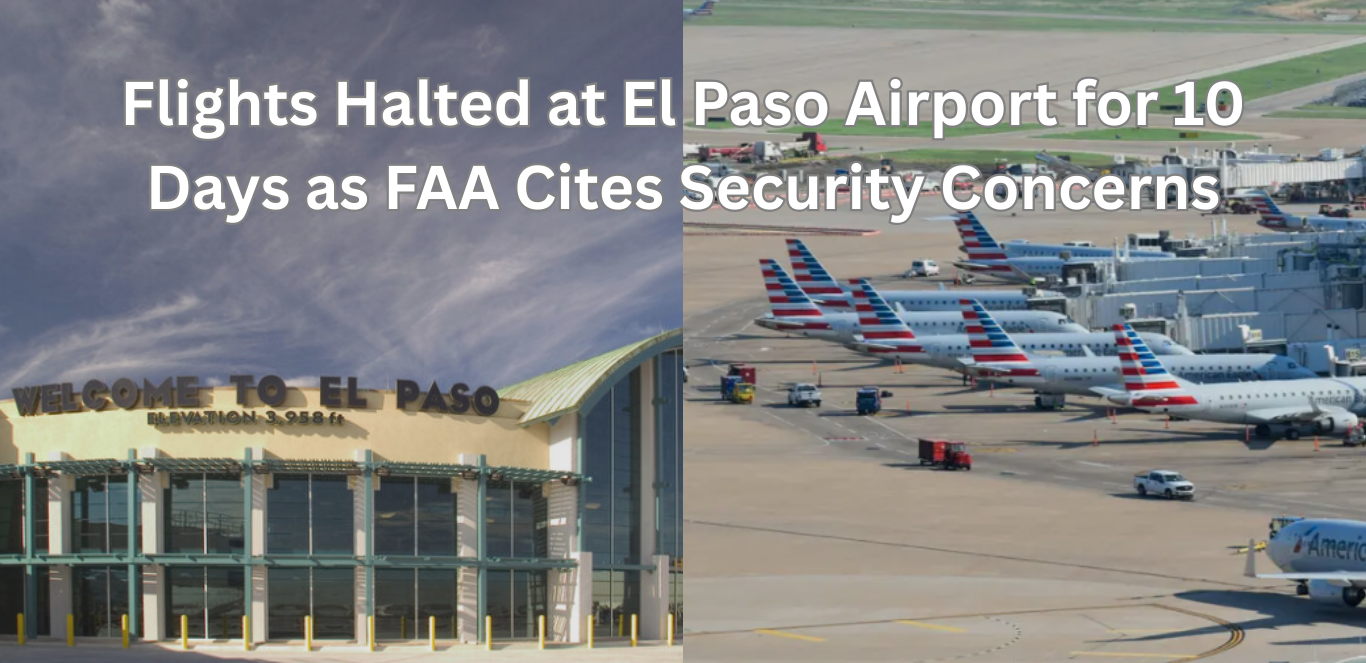
Commercial flights at El Paso International Airport were suspended for up to 10 days after the US Federal Aviation Administration (FAA) imposed special airspace restrictions for national security reasons, disrupting travel plans for thousands of passengers and raising questions about the nature of the security operation.
The FAA announced that flight operations at the Texas airport would be paused due to the establishment of National Defense Airspace, a rare measure that temporarily restricts civilian aviation activity to protect sensitive military or security operations. Officials did not publicly disclose the specific reason, citing security concerns, but confirmed that the decision was coordinated with the US Department of Defense and other federal agencies.
The shutdown took effect immediately, grounding incoming and outgoing flights and forcing airlines to reroute or cancel services. Passengers were advised to check with carriers for alternative travel arrangements, while airport authorities worked to manage disruptions and provide updates.
Table of Contents
ToggleWhat Is National Defense Airspace?
National Defense Airspace is a special designation used by US authorities to restrict or control airspace when national security activities require heightened protection. Such restrictions are typically implemented during military operations, large-scale security exercises, or when sensitive government activities are underway.
While temporary flight restrictions are common during major events or emergencies, a multi-day suspension at a commercial airport is unusual. Aviation experts say the measure reflects a significant security operation, though the lack of detailed information has fueled speculation.
Impact on Travelers and Airlines
The suspension of flights has affected thousands of travelers in the El Paso region, which serves as a key transportation hub near the US–Mexico border. Airlines have canceled scheduled departures and arrivals, and passengers have been encouraged to rebook through nearby airports such as Albuquerque or Phoenix.
Local businesses, including hotels and tourism operators, are also expected to face economic impacts due to reduced air traffic. Aviation analysts note that prolonged shutdowns can ripple across airline schedules nationwide, as aircraft and crew rotations are disrupted.

Government Response and Security Concerns
Federal officials have emphasized that the decision was taken as a precautionary measure to ensure public safety. The FAA stated that the restrictions were implemented in coordination with national security agencies and would remain in place until the designated period ends or the situation changes.
Authorities have not indicated any immediate threat to the public, and there have been no reports of an incident or attack. However, the secrecy surrounding the operation highlights the sensitive nature of national defense-related airspace measures.
Broader Context of Airspace Security
Airspace restrictions are part of broader US aviation security frameworks designed to protect critical infrastructure and prevent potential threats. Modern airspace management involves coordination among multiple federal agencies, including the FAA, the Department of Defense, and intelligence services, to monitor and respond to risks in real time.
Security measures in aviation have evolved significantly since major terrorist plots and attacks led to stricter regulations and surveillance systems. Past incidents have demonstrated how aviation security policies can change rapidly when threats emerge, leading to temporary shutdowns or enhanced screening protocols.
What Happens Next
The FAA said it will continue to assess the situation and provide updates as the restrictions evolve. Airlines are preparing contingency plans, and passengers are urged to monitor official announcements.
Experts say such airspace closures, though rare, underline the importance of aviation security in a rapidly changing global threat environment. The incident also raises questions about transparency and communication, as travelers seek clarity about the reasons behind the shutdown.
As the 10-day period unfolds, authorities are expected to determine whether the restrictions will be lifted on schedule or extended, depending on security assessments. For now, El Paso International Airport remains quiet, serving as a reminder of how national security considerations can abruptly reshape everyday travel.
Visit GPS NEWS HUB