
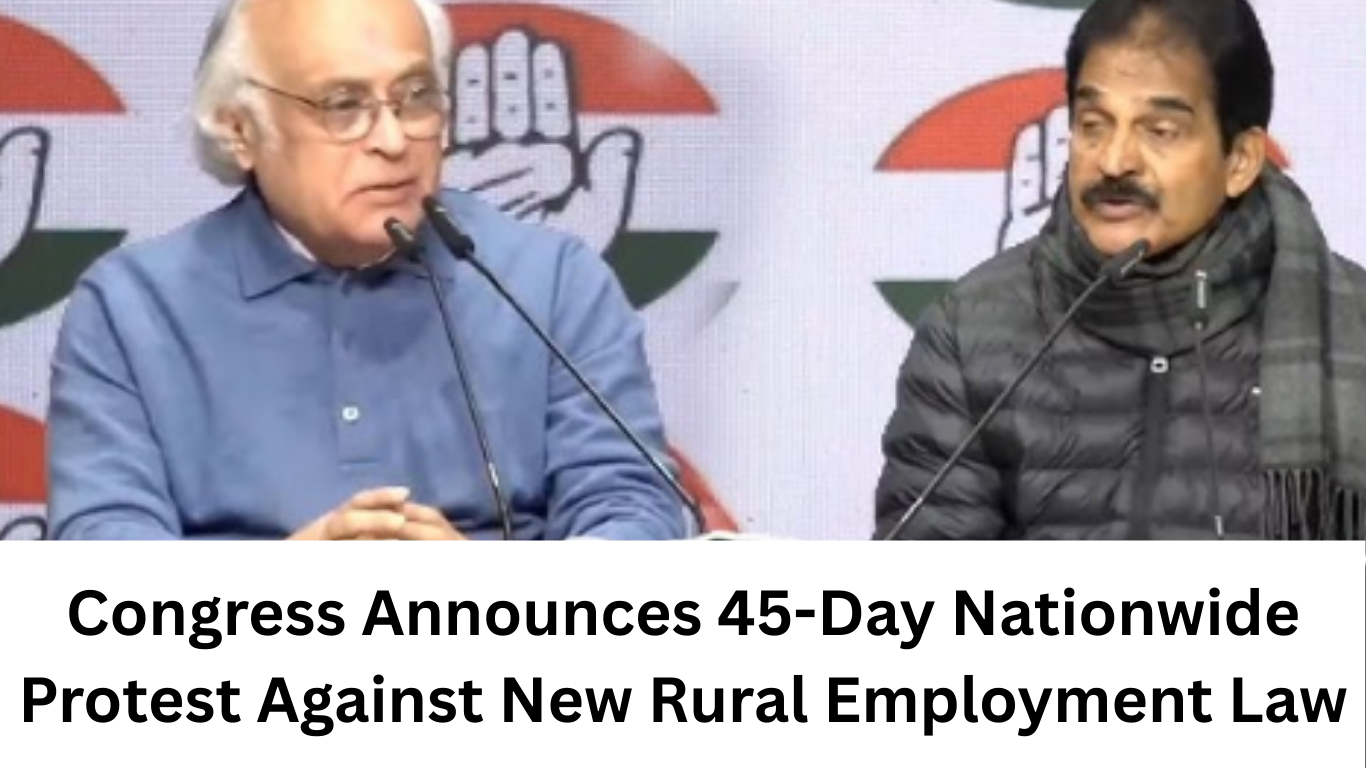
India’s main opposition party, the Indian National Congress, announced a nationwide 45-day agitation called the “MGNREGA Bachao Sangram” that will begin on January 10 and run through February 25. The movement aims to press the government to repeal the recently enacted Viksit Bharat–Guarantee for Rozgar and Ajeevika Mission (Gramin) Act, 2025, commonly known as the VB-G RAM G Act, which replaced the long-standing Mahatma Gandhi National Rural Employment Guarantee Act (MGNREGA) — a legally guaranteed rural job scheme
Table of Contents
ToggleOpposition Criticizes New Law as Weakening Rural Employment Protections

Congress leaders have framed the protest as a campaign to “save” MGNREGA, alleging that the new VB-G RAM G legislation undermines the legal right to work and dilutes protections previously available under MGNREGA. The Congress party — citing concerns from grassroots workers and local leaders — claims the 2025 law removes the rights-based nature of guaranteed rural employment and shifts control of implementation away from local governance bodies known as panchayats.
Speaking at a press conference in New Delhi, senior Congress officials said the movement would include a series of rallies, district-level meetings, and protests at state assemblies. They also announced plans for coordinated legal and political action alongside opposition-led state governments and allied political parties.
Political Context and Broader Debate
The VB-G RAM G Act, passed by the Indian Parliament in December 2025, was introduced by the ruling Bharatiya Janata Party (BJP) government as part of a broader rural employment and development framework. Government sources have defended the updated legislation, saying it increases employment guarantees and aligns rural job creation with longer-term development goals.
However, opposition parties and regional governments have raised concerns. In several Indian states, including Karnataka and Telangana, political leaders have criticized the act for increasing financial burdens on states and reducing the decision-making role of local institutions. In Karnataka, analysts estimate that the new framework could require significantly more state funding and alter long-established employment dynamics.
Similar political friction has emerged at the state level, with legislative bodies in Punjab and other regions passing resolutions opposing the new Act and urging the restoration of MGNREGA’s earlier provisions. Critics have described the replacement of the well-known rural job scheme as detrimental to workers’ rights, especially among vulnerable populations including women, Dalits, and low-income rural households.
National Political Mobilization Ahead of Elections
The Congress-led MGNREGA Bachao Sangram reflects ongoing political tensions in India over economic policy and rural welfare, particularly as the country approaches significant state and national elections. The nationwide protest aims to unite opposition parties and civil society groups around concerns about employment guarantees and federal-state relations under the new legislation.
Global and Development Implications
MGNREGA, originally enacted in 2005, was widely recognized as one of the world’s largest public works programs, legally guaranteeing employment to rural households and providing a safety net during economic downturns and agricultural off-seasons. International development observers noted that changes to the program’s structure may have both economic and social implications in India’s vast rural economy, where millions depend on guaranteed work for income stability and local infrastructure development.
Why This Matters
This protest is not only a domestic political flashpoint but also a significant development in rural public policy and employment rights in one of the world’s fastest-growing major economies. Its outcome may influence economic confidence in rural communities and parliamentary discourse leading up to elections in several Indian states later this year.
Visit GPS NEWS HUB