
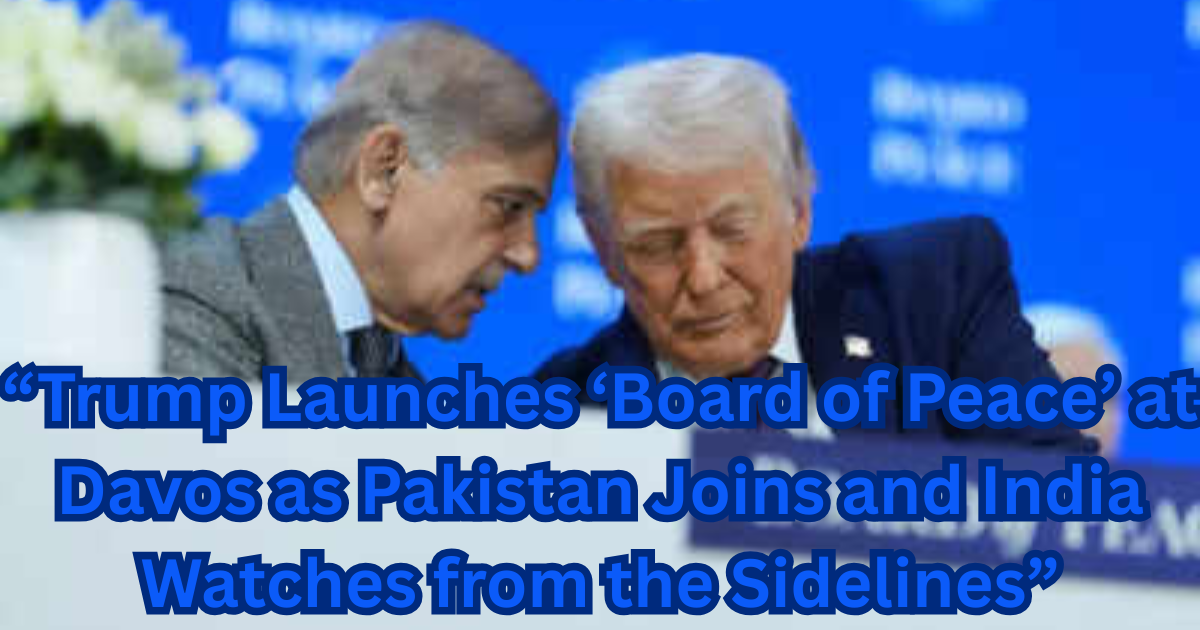
Davos, January 22, 2026: Former US President Donald Trump officially launched a new international diplomatic initiative called the “Board of Peace” during a ceremony on the sidelines of the World Economic Forum in Davos, Switzerland. The Board aims to support lasting peace and stability in Gaza and potentially help mediate broader global conflicts — though it has drawn mixed international reactions.
Pakistan’s Prime Minister Shehbaz Sharif was among the world leaders present at the signing ceremony and joined Trump’s Board of Peace by signing its charter, signaling Islamabad’s endorsement of the initiative. In contrast, India was absent from the stage, despite having received an invitation to participate. New Delhi has not publicly taken a formal position on joining the Board, reflecting diplomatic caution amid the initiative’s sensitive context.
Table of Contents
ToggleWhat Is the Board of Peace?
The Board of Peace was conceived under part of a broader plan to address the ongoing war in Gaza between Israel and Hamas, which lasted more than two years before a ceasefire took effect in late 2025. Its charter sets out an ambitious framework that goes beyond Gaza, aiming to:
- Support the implementation of a permanent ceasefire
- Mobilise international resources for humanitarian aid
- Oversee reconstruction and governance in conflict-affected areas
- Promote long-term stability and peaceful resolutions to disputes
Although initially linked to the Gaza conflict, the Board’s scope is not legally limited to that region, leading some observers to view it as a broader diplomatic tool.
Composition and Global Response
Trump has promoted the Board as a platform for world leaders to work collectively toward peace. The initiative reportedly invited around 50 countries, and several have agreed to participate so far, including Argentina, Egypt, Saudi Arabia, Vietnam and others. However, major powers such as France, the United Kingdom, China, Germany and Russia chose not to attend the signing ceremony in Davos.
Pakistan’s decision to sign on underscores Islamabad’s interest in remaining engaged with US-led diplomatic efforts, particularly through the framework of United Nations Security Council Resolution 2803, which guides peace efforts in Gaza and supports reconstruction under international oversight. The Pakistani Foreign Office said the country hopes its participation will help facilitate meaningful progress toward a lasting ceasefire, increased humanitarian support, and reconstruction that honours Palestinian rights.

India’s Position and Diplomatic Calculations
India received an invitation to join the Board of Peace and was also named among countries expected to consider membership. However, New Delhi did not attend the signing ceremony, and officials have indicated that India is weighing diplomatic considerations before making any formal decision. Analysts suggest that India’s cautious stance reflects its broader approach toward the Middle East conflict, which emphasizes a two-state solution and respect for international legal frameworks.
India’s absence, particularly given its status as a significant diplomatic actor with longstanding ties in the region, has been noted by geopolitical commentators as a deliberate choice to maintain neutrality while assessing the Board’s evolving role.
Broader Implications
The launch of the Board of Peace comes at a time when traditional multilateral institutions like the United Nations are seen by some as constrained in addressing protracted conflicts. The initiative’s broad mandate and the involvement of select member states have sparked debate about its potential to either complement or rival established global peace mechanisms.
Supporters argue that it could bring new energy and resources to conflict resolution and reconstruction. Critics, however, worry that without clear international legitimacy and inclusive participation, the Board could be perceived as a selective forum shaped by specific geopolitical interests.

Summary
Former US President Donald Trump’s Board of Peace was unveiled at the Davos summit with the aim of supporting Gaza’s transition from conflict to reconstruction and exploring broader global peace initiatives. While Pakistan’s Prime Minister joined the initiative by signing its charter alongside Trump, India was notably absent from the ceremony and has yet to formally decide on joining. The initiative has drawn participation from a mix of countries, with some major powers sitting out the signing event, highlighting differing international perspectives on this new diplomatic body.